Treatment
Non-surgical Treatment
Initial treatment should offer protection and keep pressure off the painful accessory navicular. For severe symptoms, a CAM boot or short leg cast may be recommended to provide more protection. You may need to be non-weightbearing and use crutches or a knee scooter. Your surgeon will also monitor for signs of a blood clot in the vein, especially if you have risk factors and/or previous history of blood clots.
If the symptoms are mild, wearing shoes with good arch support or adding more arch support to shoes may be enough to take pressure off the accessory navicular. Using ice and taking anti-inflammatory medication may relieve symptoms temporarily.
Surgical Treatment
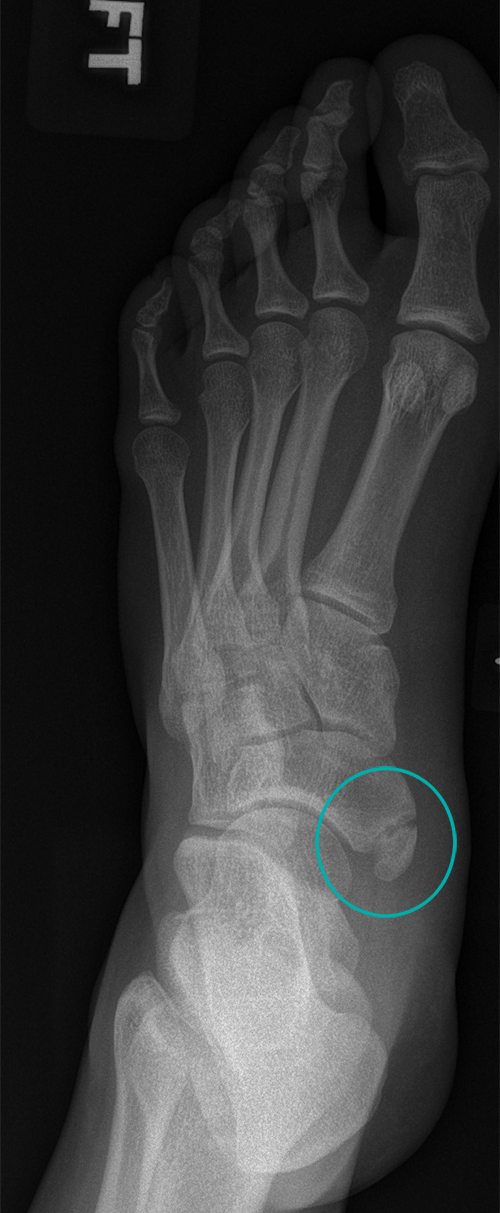
Your surgeon may recommend surgery if nonoperative treatment is not successful. The type of surgery is usually determined by the size of accessory navicular and the severity of the flatfoot deformity.
If the accessory navicular is small (type 1), then it can be removed (excised). The tendon that was attached to the accessory navicular is reattached to the navicular using suture-anchors. If the accessory navicular is large, your surgeon may remove the junction between the accessory navicular and navicular. They will then fix the accessory navicular to the navicular using small screws.
Your surgeon may perform an additional procedure(s) at the same time if the flatfoot deformity is severe enough to need correction.
Recovery
In the operating room after surgery, your surgeon will place a short leg splint to protect the bone, tendon, and incisions. This will be removed after two weeks, along with any skin sutures or skin staples. You will then get a short leg cast or CAM boot to protect the surgical repair.
Patients are usually non-weightbearing for at least six weeks after surgery to allow the bone and/or tendon to heal. At around 6 weeks, you will be able to gradually increase the weight on your foot in a CAM boot. Physical therapy typically starts at about the same time. As the foot, ankle, and lower leg get stronger, you can wean off the CAM boot and transition to shoes with good arch support.
Risks and Complications
With any surgery, there are risks of infection, bleeding, and nerve injury. For accessory navicular surgery specifically, if the accessory navicular is removed and the tendon is reattached to the navicular, it is possible that the tendon may not heal to the bone. The suture-anchor may also cause pain if it is too prominent.
If the surgery involved removing the junction between the accessory navicular and navicular and using screw fixation, the accessory navicular may not heal to the navicular (called a “nonunion”) or the accessory navicular may heal to the navicular in a suboptimal position (called a “malunion”). The hardware could also cause pain. Complications may need to be treated with further surgery.
Frequently Asked Questions
I have an accessory navicular that is not painful. How do I prevent it from becoming painful?
To help prevent an accessory navicular from becoming painful, wear shoes with good arch support at all times. This will keep excessive stress off the accessory navicular.
I have a painful accessory navicular. Do I need to have surgery right away?
No. Surgery should only be recommended if non-surgical treatment does not relieve the pain. The success of non-surgical treatment is relatively high.
Even if surgery is recommended, you do not have to have the surgery right away. While there is never an ideal time to have surgery, you can schedule the surgery when it is most convenient for you based on your work, family, vacation, and other commitments.
Original article by Wen Chao, MD
Contributors/Reviewers: Paul Ryan, MD
The American Orthopaedic Foot & Ankle Society (AOFAS) offers information on this site as an educational service. The content of FootCareMD, including text, images, and graphics, is for informational purposes only. The content is not intended to substitute
for professional medical advice, diagnoses or treatments. If you need medical advice, use the "Find a Surgeon" search to locate a foot and ankle orthopaedic surgeon in your area.